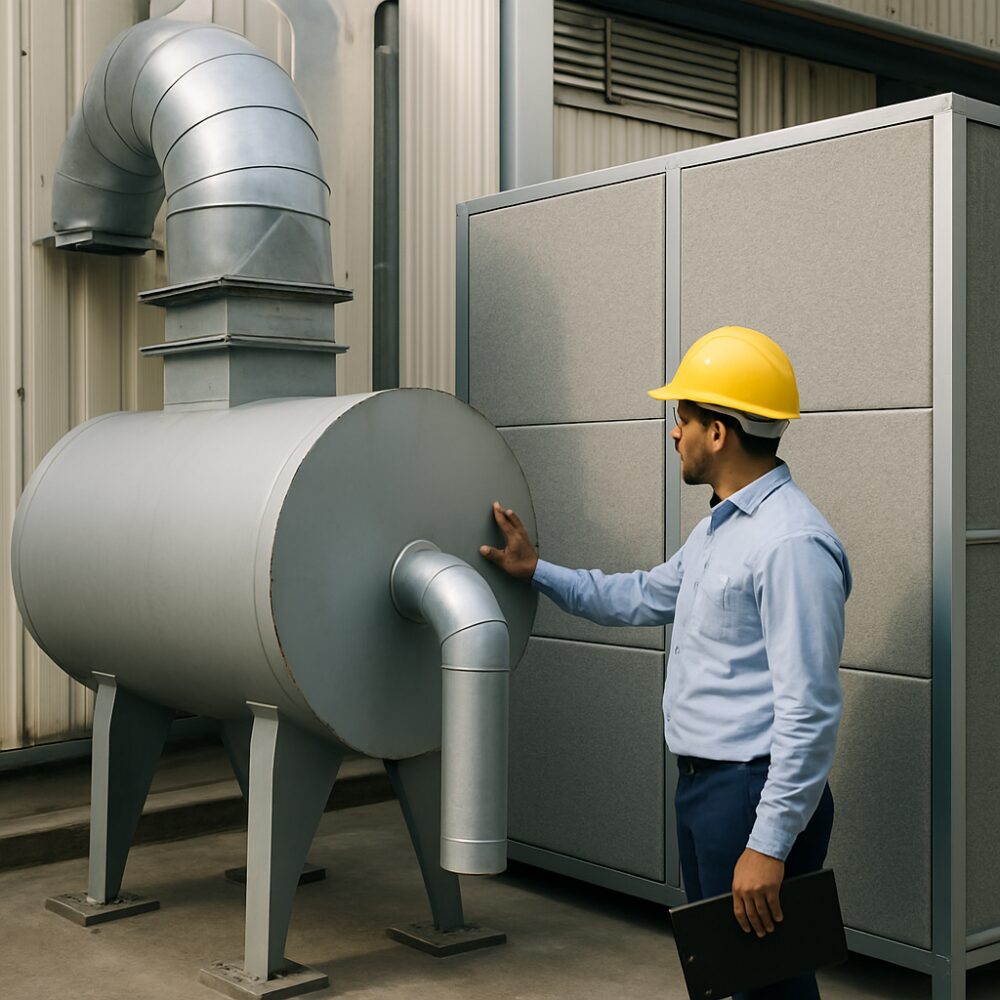
Noise from HVAC systems, fans, compressors, DG sets, exhaust ducts and air handling equipment can travel through openings and duct paths, creating comfort issues and operational concerns. In many projects, the challenge is not only the sound level but also the way noise spreads through connected spaces. An Acoustic Silencer is used to reduce airborne noise while allowing air movement or ventilation to continue effectively. For buyers, this means better acoustic control without sacrificing system function. The right solution depends on the noise source, airflow, pressure drop tolerance, duct size, space constraints and the surrounding structure.
Premium Industrial Acoustic Support
Acoustic Silencer in India
If your facility is dealing with duct noise, fan discharge noise, blower noise or ventilation-related sound spill, an Acoustic Silencer can make a practical difference. EchoShield Acoustic designs and supplies Acoustic Silencer solutions for industrial, commercial and infrastructure projects across India, with a focus on site-specific noise reduction, airflow considerations and professional installation. Our approach is simple: understand the noise source, assess the installation conditions and recommend a solution that fits the project, the process and the available space.
- Site survey and acoustic requirement review
- Site survey, acoustic design and installation coordination
- Design, fabrication, installation and follow-up support
Acoustic Project Desk
A premium project flow for requirement review, acoustic planning, quotation, manufacturing and installation support across India.
- Share project details
- Get acoustic solution plan
- Execute with clarity
Pan-India Acoustic Coverage
Acoustic and noise-control solutions for industrial, commercial and architectural projects across India.
01
Requirement Review
Share site details, machine data and noise concerns for structured next-step guidance.
02
Acoustic Assessment
Coordinate the acoustic approach based on equipment, site and performance expectations.
03
Design & Quotation
Get help with solution design, specifications, budget planning and quotation.
04
Installation Support
Stay connected during manufacturing, installation and handover coordination.
A Premium Acoustic Project Journey, Planned Step by Step
From first requirement review to installation support, the page experience guides buyers with clarity and trust.
01
Share Requirements
Send machine details, drawings, photos and noise requirements.
02
Acoustic Review
The requirement is reviewed for suitable acoustic treatment, enclosure or barrier options.
03
Quotation Planning
Receive quotation guidance based on dimensions, materials, site conditions and installation scope.
04
Execution Support
Plan design, fabrication, transport, installation and handover support.
05
Project Execution
Get coordination during manufacturing, delivery, installation and project support.
06
Project Follow-up
Continue with post-installation guidance and project support where applicable.
What This Means for You
- Controls ventilation and duct-borne noise at the source
- Supports better acoustic comfort in occupied areas
- Can be integrated with HVAC and mechanical systems
- Useful where airflow must be maintained
- Designed to suit site conditions and project requirements
What This Means for You
- Custom sizing for ducts, fans, AHUs, blowers and exhaust lines
- Material selection based on noise source and environmental conditions
- Support for industrial, commercial and infrastructure projects
- Integration with ventilation and maintenance access needs
- Supply and installation support across India
Acoustic Guide 02
Acoustic Silencer solutions from EchoShield Acoustic
EchoShield Acoustic offers engineered Acoustic Silencer solutions for new installations and retrofit projects. We work with consultants, contractors, plant teams, builders and facility managers to define the right specification for each site. Depending on the application, the design may include dissipative or reactive silencer principles, custom casing dimensions, acoustic infill selection and connections that suit the duct or equipment layout. We also support related services such as Acoustic Panels, Soundproofing Solutions, Industrial Noise Control, Noise Barrier Solutions and Acoustic Consultation so the overall noise-control strategy stays coordinated.
Acoustic Guide 03
Common applications and industries served
Acoustic Silencer systems are widely used where mechanical noise needs to be controlled without interrupting air movement or process ventilation. They are relevant across industrial sheds, utility areas, commercial buildings and infrastructure environments. EchoShield Acoustic supports buyers in India across multiple sectors, with site-specific recommendations for each application. For broader project planning, you can also explore our Industry pages, City pages and related service pages to match the solution to your location and use case.
What This Means for You
- Manufacturing plants and process industries
- DG rooms, compressor rooms and utility spaces
- HVAC systems in offices, malls and commercial buildings
- Hospitals, laboratories and institutional facilities
- Auditoriums, hotels and large public-use buildings
- Infrastructure and transport-related mechanical spaces
What This Means for You
- Casing options selected for project conditions
- Acoustic infill chosen for noise control and durability
- Compatible with ducts, fans, AHUs and exhaust systems
- Design considers airflow, pressure drop and access
- Suitable for retrofit and new-build projects
Acoustic Guide 04
Product specs and solution overview
Because every project is different, final specifications are defined after site review and engineering discussion. Typical Acoustic Silencer solutions may be designed with galvanized steel, powder-coated steel or other project-suitable casing options, along with acoustic infill selected for the operating environment. Dimensions, airflow capacity, pressure drop, connection type, access provisions and maintenance requirements are considered during design. In projects where moisture, dust or corrosion resistance matter, material and finishing choices are adjusted accordingly. For buyers comparing options, the key factors are noise source, operating airflow, space availability, installation route and long-term service access.
Acoustic Guide 05
How our Acoustic Silencer process works
Our process is designed to keep the project clear, practical and easy to coordinate. We begin with a discussion of your noise concern, equipment details and site constraints. Where required, we arrange an acoustic assessment to understand the source and pathway of the sound. Next, we recommend a suitable configuration and share a quotation aligned to the scope. After approval, we proceed with detailing, manufacturing, supply and professional installation support. This structured approach helps ensure the selected Acoustic Silencer fits the application instead of using a one-size-fits-all product.
What This Means for You
- Step 1: Site discussion and noise source review
- Step 2: Acoustic assessment and design inputs
- Step 3: Custom quotation and technical proposal
- Step 4: Manufacturing and supply
- Step 5: Installation support and coordination
- Step 6: Final checks and project handover
What This Means for You
- Better noise control for mechanical and ventilation systems
- Improved comfort for staff, visitors and nearby occupants
- Custom fit for project-specific equipment and space
- Supports coordinated acoustic planning across the site
- Helps reduce noise-related complaints and operational friction
Acoustic Guide 06
Benefits of choosing a site-specific Acoustic Silencer
A well-planned Acoustic Silencer offers more than basic noise reduction. It can improve the acoustic environment, support occupant comfort and help mechanical systems operate in a more controlled way. In industrial and commercial projects, this is especially important where equipment noise affects work areas, nearby spaces or customer-facing environments. A custom solution also helps avoid unnecessary oversizing, poor fit or airflow compromise. For many clients, the real value lies in balancing sound control, system performance and practical maintenance.
Acoustic Guide 07
Materials, installation and maintenance considerations
The right Acoustic Silencer should be designed with installation and maintenance in mind. Access for inspection, cleaning and future servicing should be considered early, especially in industrial environments. Installation must also account for duct alignment, support, sealing and the surrounding structure to avoid performance issues. EchoShield Acoustic recommends using suitable materials and construction details based on the site, including corrosion exposure, dust conditions and operating temperature. If your project also needs enclosure-style solutions, we can discuss related options such as acoustic enclosures, sound barriers or office acoustic solutions to create a complete noise-control plan.
What This Means for You
- Plan for access and maintenance from the start
- Choose materials based on site environment
- Check duct alignment and support conditions
- Coordinate with HVAC or mechanical contractors
- Include surrounding acoustic treatments where needed
What This Means for You
- Acoustic Panels for internal absorption
- Soundproofing Solutions for enclosed spaces
- Industrial Noise Control for plant environments
- Noise Barrier Solutions for external noise pathways
- Acoustic Consultation for project planning
Acoustic Guide 08
Where Acoustic Silencer projects fit into larger noise-control plans
In many facilities, an Acoustic Silencer is one part of a wider noise-control strategy. Depending on the problem, it may be combined with acoustic panels, soundproofing, vibration isolation, enclosures or barriers. For office and customer-facing spaces, explore our Office Acoustic Solutions. For production environments, our Industrial Noise Control and Noise Barrier Solutions pages are useful starting points. For performance-critical spaces, you may also review Studio Acoustic Treatment, Home Theatre Acoustic Treatment and Auditorium Acoustic Solutions. If you need help choosing the right path, Contact Us or Request Quote for a technical review.
Acoustic Guide 09
Why Indian buyers choose EchoShield Acoustic
EchoShield Acoustic supports Indian buyers who need practical acoustic solutions with clear communication and project-focused execution. Our team works with architects, consultants, builders, procurement teams and plant engineers who want a reliable partner for design, supply and installation support. We aim to keep the process straightforward while maintaining technical quality and site awareness. If your project is in a metro, industrial corridor or growing commercial zone, we can tailor the recommendation to your city, sector and installation conditions.
What This Means for You
- India-focused support for industrial and commercial projects
- Technical guidance for consultants, builders and plant teams
- Custom solutions based on site inspection and noise source
- Clear quoting process with defined scope
- Support for related pages, city coverage and project planning
Premium Concierge Support Built Into Every Page
Each page is designed to move industrial buyers from confusion to a clear enquiry with strong trust signals and conversion CTAs.
Acoustic Design Guidance
Design, material and site readiness support for acoustic project planning.
Manufacturing Coordination
Fabrication, delivery and installation communication support for projects.
Stay & Arrival Support
Airport pickup, accommodation and local support coordination where required.
Aftercare Project Follow-up
Project follow-up and handover coordination after installation.
Explore Related Acoustic Guides
Frequently Asked Questions
An Acoustic Silencer is used to reduce noise carried through ducts, fans, ventilation systems and other mechanical pathways while maintaining airflow or system function.
Not exactly. An Acoustic Silencer controls noise in ventilation or mechanical airflow paths, while soundproofing is usually used to block sound transmission through walls, enclosures or partitions.
The right type depends on the noise source, airflow, pressure drop limits, duct size, available space and installation conditions. A site assessment is the best starting point.
Yes. Many Acoustic Silencer installations are done for existing systems, provided the available space, duct configuration and operating conditions are evaluated properly.
Yes. EchoShield Acoustic can support the project from assessment and design to manufacturing, supply and professional installation coordination, depending on the scope.
Usually no. Some projects need a combination of solutions such as acoustic panels, enclosures, barriers or vibration control. The final recommendation depends on the site condition and the noise pathway.
Ready to Plan an Acoustic Project with EchoShield Acoustic?
Share your site details, machine information or noise issue. Our team can guide you with the next practical step.
Engineering Disclaimer: Final acoustic recommendations depend on site inspection, measurement, equipment details, airflow requirements, structure and installation conditions. Performance varies by project and should be confirmed through engineering review.